For PM interviews in India
Know what each round marks, without guessing what interviewers want.
You read the question lists. You still don't know how you will be scored.
One PDF guide, for PM jobs at Indian and foreign firms in India. It has a marking sheet for each of 10 rounds, and 62 answers worked in full, weak next to strong.
Get the guide, ₹299₹299 for the first 100 buyers, because the guide is new and has no reviews yet. After that, ₹499.
Not what this page says? Ask within 48 hours. You get all your money back.
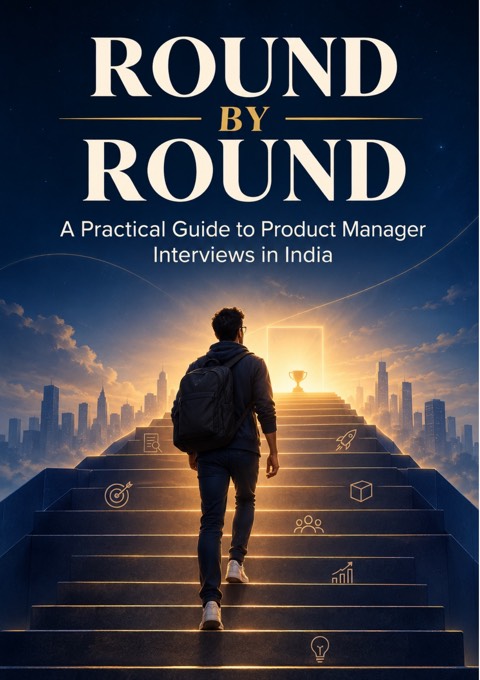
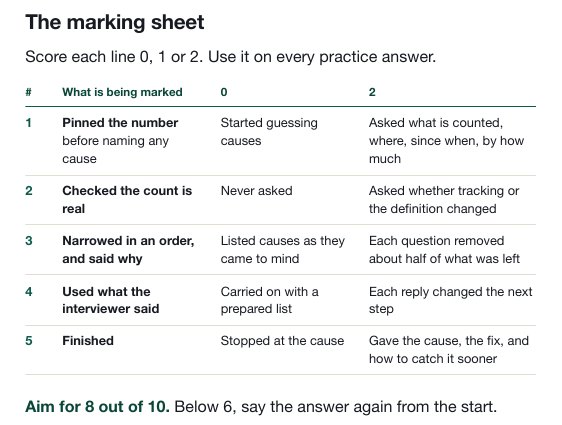
The cover, and chapter 4's marking sheet. Line 1: guessing causes earns 0. Asking what is counted, where, since when and by how much earns 2.
Read one full answer from the guide. It is one of the 62 worked answers, exactly as printed. The question: orders on a food delivery app fell 10% this week. How would you find out why?
A weak answer starts: "There could be many reasons…"
A strong answer starts: "Before I look for causes, let me make sure I understand the number."
Read both answersClose the answer
4.1 Orders on a food delivery app fell 10% this week compared with last week. How would you find out why?
What the interviewer is marking
- Do you pin down the number before you guess?
- Do you narrow in a set order?
- Do you use what you are told?
- Do you finish: a cause, a fix, and a way to catch it sooner?
A weak answer
"There could be many reasons. Maybe a competitor ran a big discount, or it rained, or there was a bug in the app. I would look at the analytics dashboard and talk to the engineering and marketing teams to find the cause."
Why it falls short: a list of guesses with no order. It asks the interviewer nothing, so it cannot use anything the interviewer knows. "Look at the dashboard" is not a method.
A strong answer
"Before I look for causes, let me make sure I understand the number. Is this orders placed or orders delivered? Is the fall across India or in some cities? Did it happen on one day or build up through the week?"
(Interviewer: orders placed, all cities, a sudden fall on Wednesday that has stayed.)
"A sudden fall on one day, everywhere, points to something we changed more than to something in the market. A competitor's offer or bad weather would hit some cities and not others, and would rarely start in one hour. So I will check inside the company first, in three steps. First, is the number itself right: did anything change in how we count orders on Wednesday? Second, what did we ship or change on Wednesday: an app release, a payment partner, a fee, notifications? Third, where in the journey do we lose people? I would compare last week and this week at each step: opened the app, searched, opened a restaurant, added to cart, reached payment, order placed."
(Interviewer: everything is the same until payment. Payment success fell.)
"Then I will cut payment success by method and by app. UPI, cards or cash on delivery? Android or iPhone? Which app version?"
(Interviewer: UPI on Android, in the version released on Wednesday.)
"So the likely cause is that Wednesday's Android release broke the UPI step for some users. Today: roll that change back or switch it off, and confirm payment success returns. This week: message the users whose payments failed, since they wanted to order. After that: an alert on payment success by method and app version, so a fall like this is seen within the hour and not at the end of the week."
What made it strong: every question removed half the possibilities. It said why inside causes came first. It ended with a fix and a way to prevent it.
Follow-ups to expect
- "Suppose nothing was released on Wednesday. Where do you look next?"
- "The fall is only in Bengaluru. How does your approach change?"
- "How would you size what this cost us?"
Make it yours
Practise this aloud with any number: sign-ups, repeat orders, wallet top-ups. Keep the same order every time.
That was 1 of the 62 worked answers.
Get the guide, ₹299Interviews are marked.
Google's own hiring page says: "Every candidate is assessed using clear rubrics." A rubric is a marking sheet.
Google, "How we hire", read on 21 November 2026. Round by Round is not connected with Google.
The marking sheets in this guide are its own, not Google's or any other firm's. There is one for each of the 10 kinds of round. They were made for this guide, from firms' own pages, published guides and what candidates wrote.
This guide gives you a marking sheet for each round.
What is inside
-
Know how each kind of company runs its rounds. Foreign companies hiring in India, and Indian product companies. Each company's facts name their source.
Which means you get ready for the rounds you will sit.
-
Score your own answer out of 10. A five-line marking sheet for each of 10 rounds: product sense, RCA ("why did this number drop?"), guesstimates, metrics, strategy, behavioural and four more.
Which means you see which line lost you marks.
-
Hear what a strong answer sounds like. 62 answers worked in full. Each one shows a weak answer, a strong answer, and the follow-up questions.
Which means you see why the weak one falls short.
-
Practise every question, not only the worked ones. 263 questions in all. Each one has what is marked and the mistake that loses it. Many are set in India: Indian apps, cities, rupees and UPI.
Which means you can check any answer you give.
-
Start a guesstimate from a real number. Indian figures, each with its source and year.
Which means you can say where your starting number comes from.
-
Build your answers from your own work. A story bank and its worksheet, and a table to match your stories to the values of the company you are meeting.
Which means you end with your own answers, not ours.
How much time do you have?
The guide opens with a start-here page. It tells you what to read for the time you have.
- Interview in 3 days? Use the 3-day plan. Day 1 is your stories. Day 2 is your rounds. Day 3 is the company. Plan on four or five hours a day.
- Two weeks? Use the 14-day plan. It takes one chapter a day and has three practice interviews: a friend plays the interviewer, or you record yourself. Plan on about two hours a day, three on a practice day.
- A month? Do the 14-day plan. Then use the second fortnight for what it leaves out, led by your lowest scores.
In every plan, you say each answer out loud and score it on the marking sheet. Aim for 8 out of 10. Each round also has a ten-minute drill you can do alone.
Two kinds of company. Two kinds of round.
Foreign firms hire PMs in India. So do Indian product firms. Their rounds are not the same. Part 1 of the guide covers each kind on its own. Here are three of its rows.
| Foreign companies in India | Indian product companies | |
|---|---|---|
| Length | Weeks to months | Days to a few weeks |
| What weighs most | Behaviour against published values, and case rounds marked on set criteria | Cases on the company's own app; your past work in depth |
| Tests | A writing task or take-home at some | Take-homes at several. SQL and aptitude tests at some. |
Who made this
Tanmay Upasani, a working product person and co-founder at Sarthi AI and Peppi AI.
How it was made: it was built from the sources listed at the back. These are mainly the companies' own hiring pages, published guides, and what candidates wrote about their interviews. We checked each fact and number against its source. Tanmay Upasani reviewed the guide. The answers and marking sheets are new, made for this guide.
You can open three of the sources yourself. Google's page is "How we hire". Amazon has a page on PM interviews. Razorpay has a post on how it hires PMs (2019).
Found a mistake? Write to tanmayupasani.9797@gmail.com.
This is for you if
- you have PM or APM interviews coming up;
- you are moving into product from another job;
- you have read question lists and still don't know how answers are scored.
This is not for you if
- you want someone to check your answers live. A guide cannot do that;
- you are not getting interview calls yet. This guide does not fix a CV;
- you want a promise. No honest guide can promise an interview, an offer or a salary.
The roles this is written for
These are PM jobs at product firms in India, Indian and foreign. They often pay ₹14 lakh a year or more.
Source: Levels.fyi, PM salaries reported in India, read on 21 November 2026. Of about 1,500 salaries, three in four were above ₹29 lakh a year. Associate roles often pay less: PayScale's median base pay for associate PMs in India is ₹10 lakh (182 profiles, September 2026). This guide helps you prepare. It does not promise a job or pay.
₹299
₹299 for the first 100 buyers, because the guide is new and has no reviews yet. After that, ₹499. That is the whole price. Nothing is added when you pay.
- One PDF.
- You get it on screen right after you pay, and by email within about 15 minutes.
- Pay by UPI or card, through Razorpay.
Not what this page says? Ask within 48 hours. You get all your money back.
Reading this inside Instagram or Facebook? If the payment does not open, open this page in Chrome or Safari.
Not what this page says? You get your money back.
Write to tanmayupasani.9797@gmail.com within 48 hours of buying. Say what was missing. We refund the full amount: every rupee you paid. This covers the guide and the cheat sheet.
Questions
- Is this for freshers?
- It is for PM and APM interviews. A fresher going for those roles can use all of it. Chapter 10 has a short answer to "You have never worked as a product manager. Why should we consider you?": what is marked, the order to say it, and the mistake that loses it.
- Is it only for Indian companies?
- No. Part 1 covers foreign companies hiring in India and Indian companies on their own. Their rounds differ.
- Does it cover my company?
- Part 1 names these, some in only a few lines, each company's facts with their source: Amazon, Google, Microsoft, Atlassian, Uber and Salesforce, with Meta, Intuit and Stripe in brief; Flipkart, Swiggy, Blinkit, Zepto, Razorpay, PhonePe, Meesho, BrowserStack and Freshworks. It does not cover CRED, Zoho or Zomato, and says so. For any company, ask the recruiter which rounds you will sit. Then use the chapter for each round.
- Can't I just ask ChatGPT?
-
You can. On 21 November 2026 we asked ChatGPT (the free version) and Claude for 250 PM interview questions with answers. Claude gave 40 and offered the rest in batches. ChatGPT gave 250 short answers. Neither gave a marking sheet. Here is free ChatGPT's answer to one of them, word for word:
What if DAU suddenly drops by 20%? "Validate instrumentation first. Segment the drop by cohort, platform, geography and channel; check releases, crashes, external events and acquisition quality. Diagnose before proposing a solution."
It is not wrong, but it is a list of things to check. Chapter 4's marking sheet, for this kind of question, scores five lines:
- Pinned the number before naming any cause
- Checked the count is real
- Narrowed in an order, and said why
- Used what the interviewer said
- Finished: the cause, the fix, and how to catch it sooner
Read the answer above and decide.
- Does it have the exact questions a company will ask me?
- No guide can know that. It has the kinds of questions reported for these rounds, and how they are scored.
- Will it get me the job?
- No guide can promise that. The interviewer, the other candidates and the role decide it. What you control is how ready you are. The guide helps you prepare: you score your own answers on its marking sheets and fix the weak lines before the day.
- How do I get it?
- On screen right after you pay, and by email. If neither arrives, write to tanmayupasani.9797@gmail.com with the payment ID from Razorpay's receipt.
- Can I get a refund? Do I get a receipt?
- Yes. If the guide is not what this page says, write to tanmayupasani.9797@gmail.com within 48 hours of buying, with the payment ID, and say what was missing. You get the full amount back. This covers the cheat sheet too. Razorpay emails you a payment receipt. Full terms: Refunds.